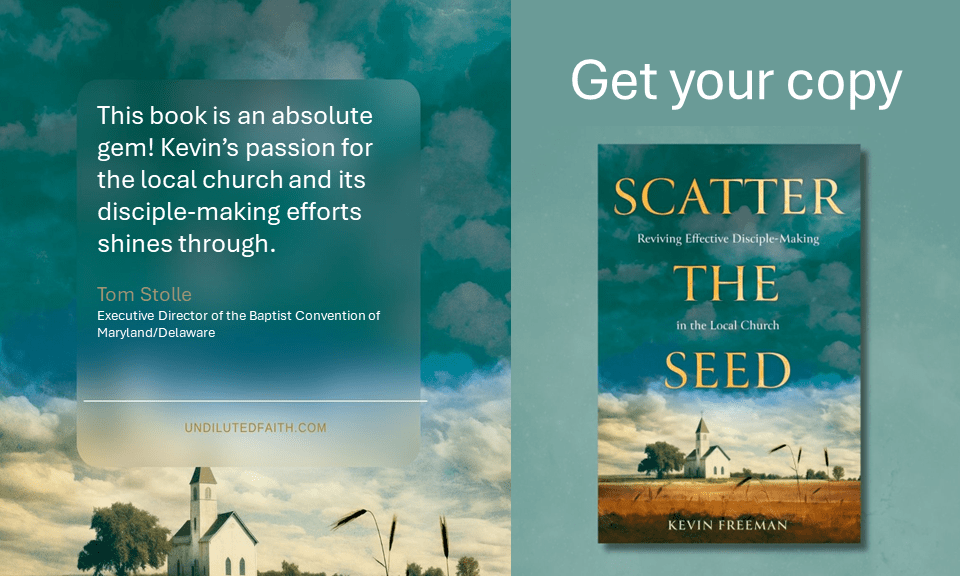
Scatter the Seed book is now available!

Dear Friends, I am excited to announce that Scatter the Seed has officially published! Many of you have prayed and supported me in this journey, and I thank God for your encouragement. This book will help churches more effectively fulfill their Great Commission call. Pick up your copy here.

After learning from this easy-to-read book, my fervent prayer is that, through God’s Spirit, it will reignite our hearts to get back to the basics of evangelism and discipleship as Jesus instructed. It certainly has mine!

Dr. Peter W. Teague, President Emeritus of Capital Seminary & Graduate School at Lancaster Bible College

Read it with a team for the greatest impact.

Get your leadership team on the same page and strategize around the vision together. Each chapter has discussion questions that teams can use to prayerfully plan their mission together. Bulk copies of 10+ are available at a discounted rate. Contact Kevin to arrange this.

Kevin Freeman has given us a remarkably thought-provoking and practical book based on Jesus’s two dynamic objectives in the Great Commission—to make and teach disciples. He helps us answer this important question: To what extent do we have these supracultural directives in balance? This is an immensely helpful book!

Dr. Gene A. Getz, Professor, Pastor, and Author; Founder of bibleprinciples.org; Host of Renewal Radio

What can you expect from Scatter the Seed?

Discover why most churches struggle with lukewarm discipleship and anemic outreach – and how to improve.

Equip yourself with tools to develop your strategy and align your church around it.

Creatively consider how to DREAM: Develop the mission, Recruit by the mission, Evaluate by the mission, Allocate for the mission, and Motivate by the mission.

More praise for Scatter the Seed

This book is an absolute gem! Kevin’s passion for the local church and its disciple-making efforts shines through. Thoughtful, practical, and truthful, he shines a light on an area in which far too many churches fall short: the making of disciples. I was encouraged, challenged, and convicted as I consumed this powerful work. Thanks, Kevin, for the reminder that we are called to make disciples, contributing to the next generation of people who will not only say “Jesus is Lord” but will follow Jesus as Lord!

Tom Stolle, Executive Director of the Baptist Convention of Maryland/Delaware

Kevin Freeman lives his life with Great Commission intent. Scatter the Seed is a guidebook that not only outlines the importance of proper disciple-making—that special combination of evangelism and spiritual formation—but also presents a clear and reasonable look at how the true mission of the church can be restored. This book can motivate Christ followers toward fulfilling the Great Commission within their lifetime.

Dr. John B. Brittain, Associational Mission Strategist at West Central Baptist Association, Missouri

This book is a beneficial resource, rooted both in Scripture and our modern context. It clearly points us to our primary call to make disciples and practically describes how to be faithful to that mission.

Dr. Daniel Hyun, Church Partnership Team Leader at Baptist Convention of Maryland/Delaware; Adjunct Faculty Member of Church and Ministry Leadership at Lancaster Bible College

Many congregations seem unclear about their mission in God’s Kingdom plan. Further, they lack the ability to evaluate the fruitfulness of their present efforts and programming. Kevin Freeman, informed by Scripture and years of ministry experience, provides helpful analysis and encouragement from a foundational parable rooted in Matthew’s and Luke’s Gospels.

Dr. Kevin Smith, Pastor of Family Church Village in West Palm Beach, Florida

I had the privilege of teaching Kevin in multiple seminary classes and spending time with his family outside the classroom. Kevin consistently displayed not only a sharp intellect but a creative mindset. He has masterfully combined both those traits in this book. Biblically based, creatively written, and with a focus on application, I heartily endorse this work. It will force you, as it has forced me, to think about evangelism and discipleship in new and helpful ways.

Dr. Timothy Beougher, Associate Dean of the Billy Graham School of Missions, Evangelism, and Ministry at The Southern Baptist Theological Seminary

Evangelism and discipleship, as Kevin Freeman shows us, are not a bifurcated “either/or” but rather a “both/and”endeavor. Employing the Parable of the Sower and extrapolating it into future fictional generations, Freeman creatively shows how the church has abandoned Jesus’s original plan of scattering the seed of God’s Word in favor of ineffective and far less optimal alternatives. The resulting harvest has been mediocre rather than bountiful. But Freeman also shows a better way: one that appreciates the integral relationship between evangelism and discipleship to empower the church to make disciples who make disciples. As Freeman says, “The sustained success of both evangelism and discipleship is found when they operate in concert.” This book will equip the church to do exactly that.

Mark Dooley, State Director of Evangelism at Baptist Convention of Maryland/Delaware

Scatter the Seed is a must-read for any Christian wanting to refocus on fulfilling the Great Commission of Matthew 28:18–20. Kevin Freeman defines the nature of true discipleship and provides wise counsel to enable believers to be more effective in cultivating followers of Jesus. This book is engaging, practical, and firmly grounded in Scripture.

Dr. Mark R. Meyer, Director of Biblical Studies at Lancaster Bible College; Pastor of Halethorpe Community Church


Kevin Freeman’s approach to ministry is to integrate discipleship with evangelism, an often-overlooked strategy. He is like a modern-day Johnny Appleseed who believes that the Great Commission of Jesus Christ (Matt. 28:18–20)—going, baptizing, and teaching to obey—is indeed the church’s mission and is best described through the organic metaphor of a farmer casting seed. The aim is to reorient Christians in their mission to make disciples and to depend upon God for growth and fruit. Freeman’s ideas are based on sound research and years of experience in ministry—and are easy to understand. In a world of ministry fads that come and go, this book is a needed addition to help churches grow deeper in their understanding and practice of discipleship.

Dr. Ron R. Blankenship, Director of Missions for Montgomery Baptist Association in Maryland; Adjunct Professor of Practical Ministry and Biblical Studies at Washington University of Virginia

In a culture that offers many avenues for Christ followers to pursue, Kevin lays out a compelling message, explaining that at all times the Christian can and should embrace Jesus’s Great Commission call to be the disciple He wants them to be. This book will help reinvigorate you and your leadership team toward God’s call and realign it with a more effective and achievable ministry strategy.

Maina Mwaura, Minister, Public Speaker, and Journalist; author of The Influential Mentor: How the Life and Legacy of Howard Hendricks Equipped and Inspired a Generation of Leaders

Kevin Freeman makes a compelling argument for balanced discipleship and evangelism in the church today. From the Parable of the Sower, Kevin helps us see the need to use time-honored methods for reaching and discipling people while being open to new methods in successive generations. The church has scattered the seeds of the gospel for over two thousand years, and in whatever time that remains, we must be adaptive and hardworking to reach and disciple more people. Kevin’s book is an important work for the church and its leaders today. It’s well worth your time and investment—read it with others to multiply its impact.

Ken Braddy, Director of Sunday School & Network Partnerships at Lifeway Christian Resources
Inventive Expressions

Have you heard of the monowheel?

While looking up inventions recently, I came across one that immediately caught my interest. The futuristic-looking “Motoruota” was invented a hundred years ago, patented in France in 1924! David Cislaghi and Giuseppe Govetosa were the named inventors on the patent. Because they were never widely popular, these “monowheels” are shrouded in a bit of mystery, though they were featured in the December 1924 edition of Popular Science Monthly. It is said that the Motoruota could reach speeds of nearly 100 miles per hour.

We have enjoyed rapid technological inventions nearly nonstop for the past 150 years. This can lead us to always look to the next gizmo or updated version of a product we love. Perhaps we are sometimes too quick to disregard the inventions of the past. A few marvels lie buried that are worth some scrutiny, and, if we are honest, not all of today’s inventions are worthy of accolades.

As we live out our faith, we can be guilty of looking for the next innovation to propel us forward, though what lies in the past is often much more fruitful. We seek the next worship song, popular speaker, Christian living book, conference, or catchy verse. These are not bad, but they can leave us continually skimming the surface, looking for the next exciting thing that will boost our faith.

In truth, Christians should embrace both the old and the new, the things that stand the test of time and those new expressions of hope that will propel us forward.

God reveals this in His Word:

Remember the former things of old; for I am God, and there is no other; I am God, and there is none like me.

Isaiah 46:9, ESV

But just a few chapters earlier, we read:

Remember not the former things, nor consider the things of old. Behold, I am doing a new thing; now it springs forth, do you not perceive it? I will make a way in the wilderness and rivers in the desert.

Isaiah 43:18-19, ESV

Even at the end of the Bible, God declares He is “making all things new” (Revelation 21:5). In the next verse, He reminds us that He is the beginning and the end. The trustworthy truths of the past will always hold their value, and we can eagerly embrace new expressions of those same principles. That is because our God is the God of every moment in time!

What aspects of God’s past faithfulness do you treasure? How will you live out the hope He has placed in you in a new way in the coming days?

Image attribution: Nationaal Archief, (https://creativecommons.org/licenses/by-sa/2.0/)

Made to Shine

Image from arcpublishing.com*

In Philadelphia there lies an impressive-looking building that once housed St. Paul’s Presbyterian Church. Built in 1901, this structure has fallen into disrepair like so many old church buildings. Thankfully, new life exists within, as another congregation – Emmanuel Christian Center – bought the building and set about renovating it. Part of the renovation process involved the removal of two large, grime-covered circular windows that were high up on the wall.

The windows were in such bad condition the church initially planned to demolish them. Instead, they offered a salvager the opportunity to buy the windows and remove them. They sold them for $6,000 apiece to Paul Brown, who extracted and sent the windows to an auction house. Upon appraisal, Brown learned these were original rose windows made in 1904 by the famous Tiffany Studios company. After being cleaned up, the windows fetched $100,000 apiece!

Do you know the original purpose of rose windows? These Gothic features developed around the 12th century allowed more light into the building and represented the light of God illuminating His creation. The image of divinity was often circular – think of the round halos depicted behind Christ’s head – so churchgoers could look up and be reminded of God’s glory or down to see the beautiful colors arrayed by the light passing through beautiful stained glass. The intricate geometrical patterns reflected the order of the universe and of a life submissive to the Lord’s precepts.

We are like rose windows, but we often feel like those filthy ones found in Philadelphia. The dirt and grime of life – past mistakes, failures, and the trials of age – become caked to us, obscuring our beauty and value. We forget that God has made us in His image, that through faith in Christ we have been not only forgiven of our sin but enabled to live holy lives. God has made us to be gorgeous and priceless windows that display the light of God’s glory and goodness for all the world to see!

Peter the apostle made enough mistakes that he likely felt he had ruined any opportunity to be useful again, but consider what he later wrote:

“But you are a chosen people, a royal priesthood, a holy nation, God’s special possession, that you may declare the praises of him who called you out of darkness into his wonderful light.”

1 Peter 2:9, NIV

And later:

“His divine power has given us everything we need for a godly life through our knowledge of him who called us by his own glory and goodness. Through these he has given us his very great and precious promises, so that through them you may participate in the divine nature, having escaped the corruption in the world caused by evil desires.”

2 Peter 1:3-4, NIV

God made you to display the light of Christ to the world, and He has equipped you with everything you need to do so. If there is a sin struggle in your life, you are able with God’s power to remove that grime and better demonstrate the order of God’s love. Walk confidently then, knowing that God is at work shining through you!

Image source: https://www.inquirer.com/resizer/uwHmcUIR_7ypuaS68isvF1NpZRo=/800×533/smart/filters:format(webp)/cloudfront-us-east-1.images.arcpublishing.com/pmn/HFBMGNG2N5BXBETDRTFSEXRWKA.jpg

Staying Fluent

My family subscribes to a youth news program called World Watch. Recently on this program, Chloe Hendon reported on a language known as Jèrriais. This Norman French dialect has been preserved over a thousand years due to its isolation on the island of Jersey, where it is spoken. Now, however, about 500 mostly elderly Jèrriais speakers remain.

Around the turn of the 20th century, Jersey adopted English and French as the official languages, viewing Jèrriais as the commoner’s tongue, and schools stopped teaching it. From there, Jèrriais continued to steadily decline.

By 2001, Jersey sought to reverse the near-extinction of their language, offering free courses and even reintroducing it into primary schools. Jèrriais was also redesignated an official language of Jersey in 2019. Will these efforts be enough to keep Jèrriais from dying out? Time will tell. Atticus Mawby, a young adult speaker of Jèrriais, explained, “No culture is complete without its language…If Jèrriais does die, then Jersey will just become another part of Britain. It will be really sad.”

Mawby is correct, and his comments extend far beyond Jersey’s language and culture. Our own Christian faith and culture have been preserved by generations who poured themselves into the next generation, faithfully immersing their young people in the truths of our faith. Ironically, the people of Jersey were so immersed in their language that they did not realize the role it had played in keeping their cultural continuity. For a hundred years, fluent speakers watched as their children learned a new language, little realizing it might erase their own cultural heritage. We, too, find ourselves with a choice to either adopt the new cultural norms around us or hold fast to the faith heritage that prior generations have given us.

Do we want our young people to be fluent in our Christian faith? If so, we must immerse them in it. On a church ministry level, this means that programs involving our young people should be the last areas where we struggle to find volunteers. On a family level, it means that parents and grandparents – knowing that they model each day what their priorities are – seek to faithfully immerse their children in a lifestyle oriented toward godliness.

Speaking of passing along Scriptural truth, the Psalmist Asaph writes,

We will not hide them from their children, but will tell a future generation the praiseworthy acts of the LORD, his might, and the wondrous works he has performed.

He established a testimony in Jacob and set up a law in Israel, which he commanded our ancestors to teach to their children so that a future generation — children yet to be born — might know.

They were to rise and tell their children so that they might put their confidence in God and not forget God’s works, but keep his commands.

(Psalm 78:4-7 CSB)

What “language” are you passing along to the next generation?

Image attribution: Man vyi, https://www.flickr.com/photos/39904966@N00/3094304063/in/photostream/ (https://creativecommons.org/licenses/by-sa/2.0/)

Fish Stories

Image by Khalid Mehmoodfrom Pixabay.

This time of year, the only amazing “catches” we might hear about relate to football, but fishing aficionados love to talk about their fish stories, too. You may have heard a few whoppers in your day, but I came across a fish story that involves a catch even more amazing than landing some big, elusive fish nicknamed “Bubba.”

An ABC news report describes a fishing trip that 14-year-old Connor Halsa enjoyed with his grandfather in northern Minnesota, when Connor made a startling catch. He reeled in a wallet, which contained $2,000 cash! Eventually, Connor was able to track down the wallet’s owner, Jim Denney of Iowa. Jim came to retrieve the wallet and was impressed that Connor turned down his offer of reward money. Jim gave Connor a custom fishing cooler and took the family to dinner as a thank you. I love what Connor said when asked why he was honest and returned the cash: “We didn’t really work hard for the money. He did, so it was his money.”

As Christians, we are familiar with Christ’s command to be “fishers of men.” Mark 1:17 says, “And Jesus said to them, ‘Follow me, and I will make you become fishers of men’” (ESV). That promise can sometimes feel daunting and overwhelming. We strive to follow Jesus, but our fishing skills sometimes seem lacking. When I go fishing – for fish – I know the basics but lack the sense to know where the fish congregate, what time of day is best, or what angle I should cast from relative to the sun’s positioning. Experienced fishermen know these sorts of things, but when I consider them, I figure it’s best that I not cast my line into the water at all.

Have you considered that Jesus simply wants us to cast a line into the water? Following Him is more about fishing than catching. Experienced fishermen have had days with rotten luck, while newbies have enjoyed amazing days without knowing why.

But none of them can catch anything if they don’t cast a line into the water, just as Connor would not have caught that wallet without casting his line. Maybe his line had snagged a few times earlier on a stick or seaweed, or it may have even snapped on an old tire. Maybe that’s how you feel.

We all have had trouble when attempting to fish for people – to share our faith and connect people to Christ and to fellowship with other believers. If that has kept you from “fishing” recently, are you ready to try again? How might you cast a line into the water this week?

Who knows what fish stories you will tell!

Tap into the next generation with one simple trick

Image by Cambridge_Spark from Pixabay

“I don’t understand why the younger people aren’t helping with ministry needs. We’ve served our time! Now we’re old.”

Those words were spoken by a frustrated senior adult who had faithfully served in ministry for many years, yet, she lamented that no one from the next generation was waiting in the wings to relieve her. Many saints toil for decades and come to the same frustrating conclusion: the next generation isn’t there to carry the ministry torch.

It becomes easy for one generation to cast aspersions at the other. “They’re lazy and self-centered.” “They don’t understand what we go through.” This tension won’t resolve itself and will instead leave both sides frustrated.

So, what is the trick to avoiding this heartache and seeing ministry efforts embraced by subsequent generations?

Involve the next generation early.

That’s it.

God commanded the older Levites to retire early so that the next generation could bear responsibility for the care of the tabernacle.

“In regard to the Levites: From twenty-five years old or more, a man enters the service in the work at the tent of meeting. But at fifty years old he is to retire from his service in the work and no longer serve. He may assist his brothers to fulfill responsibilities at the tent of meeting, but he must not do the work. This is how you are to deal with the Levites regarding their duties.”

Numbers 8:24-26 CSB

This is a great example of a seasoned generation providing valuable insight and support to the next generation, who must take on the work. The retired Levite would likely be in the prime of his career. At 50, he has many worthwhile years to contribute, and valuable experience has replaced heady enthusiasm of youth. God commands his retirement, yet he may put on the supervisor hat for the next generation who will take his place.

We may find a need for a similar system. In ministry life today, we often find that the younger people aren’t filling the gaps of service to carry on the work of the ministry. In some cases, this happens because there is no system in place to intentionally create space and support for them to serve. 

Here’s an example of how this might play out. A person aged 50 is likely more experienced and capable than the 25-year-old. In a couple of decades, the older person may be less capable, and the younger person is gone. He wasn’t needed, so he left or has made other commitments. His 15-year-old has no model of service to follow. The now 70-year-old wonders why no one is there to carry on the work and begrudgingly continues.

Let’s change the story now. If the 50-year-old invites the 25-year-old to help take on the role, the 25-year-old – who, let’s face it, is more likely to say yes and feel excited to be needed for something important at that age – can gain experience for a few years with an excellent advisor. When that advisor is 70, the work has carried on well for a couple of decades and can nudge the now 45-year-old to consider whom to tap for future leadership.

It is less about the capability of the 50 (or 60 or 70) year-old and more about the continuity of the work that God has called His people to carry out.

What is your church’s strategy for involving the next generation in the work of the ministry and the development of future leaders?

Endzone Dance

Image source: Instagram/JimKelly1212 https://www.instagram.com/reel/CxePIrEM0PR/

“The minute you have fame, and if you’re trying to chase status and money and all this stuff, you’ll lose your life — rather than denying yourself, picking up your cross, keeping your eyes on Jesus and His promises…that’s life, and that’s a life worth living.”

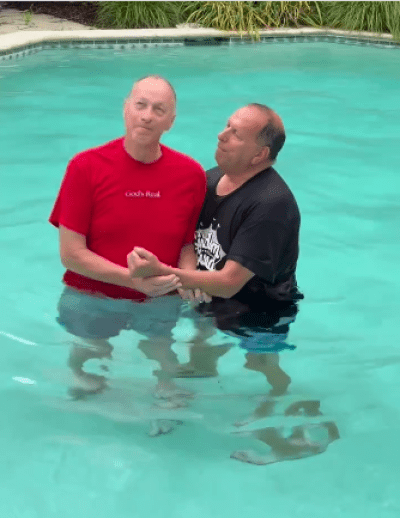
Last September, former National Football League quarterback Jim Kelly celebrated a milestone in his life. Kelly is no stranger to milestone accomplishments. While playing for the Buffalo Bills in the early 1990s, Kelly led his team to a record four consecutive Superbowl appearances. Tragically, for Bills fans, each of these games ended in a loss. In 2002, Kelly was inducted into the NFL Hall of Fame. During retirement, he faced two serious bouts with cancer and prevailed. What was Jim Kelly’s milestone in September? He was baptized! Posting a video of his baptism on social media, Kelly shared the following:

“I’m not a man of many words and I don’t speak ‘Christianese.’ All I know is that God changed my life…I’m far from perfect but God helped me humble myself and seek him for help. Becoming a Christian is the best decision I’ve made in my life. I wish I would’ve come to him sooner. But his timing is perfect.”

https://www.christianpost.com/news/nfl-legend-jim-kelly-gets-baptized-god-changed-my-life.html

This Sunday, Brock Purdy will quarterback for the San Francisco 49ers in Superbowl LVIII. Purdy, barely 24 years old, is already an outspoken Christian living for God’s glory. His rise to NFL glory has been surprising, but he continues to stay grounded in Christ alone. When interviewed by Sports Spectrum, Purdy shared about the vanity of seeking after the things of this world:

“The minute you have fame, and if you’re trying to chase status and money and all this stuff, you’ll lose your life — rather than denying yourself, picking up your cross, keeping your eyes on Jesus and His promises…that’s life, and that’s a life worth living.”

https://sportsspectrum.com/sport/football/2024/01/29/brock-purdy-49ers-super-bowl-glorify-god/

That perspective for a rising star is refreshing! I’m sure that Jim Kelly, whose career ended more than 20 years ago, would heartily agree. Chasing the things of the world – fame, fortune, comfort, or happiness – cannot compare to the glory that comes from living for Christ. “My identity can’t be in football,” Purdy explained. “It can’t be in the things of this world. It’s got to be in Him.”

Amen!

Where is your identity found?

These NFL players are following the same “playbook” that you and I use. Football players are known for celebrating touchdowns with endzone dances. Those short-term celebrations are nothing compared to what we can celebrate in eternity. This is how Paul described our calling to focus on things of eternal glory rather than the temporary pursuits of life:

Since, then, you have been raised with Christ, set your hearts on things above, where Christ is, seated at the right hand of God. Set your minds on things above, not on earthly things. For you died, and your life is now hidden with Christ in God.

Col 3:1-3 NIV

That heavenly perspective reminds us that our endzone dance is not in this life but in the next. Our hearts can easily drift. Ask yourself, how often do I dwell on “things above”? Brock Purdy and Jim Kelly are examples that, whether early or late, any time is a good time to begin focusing on Christ.